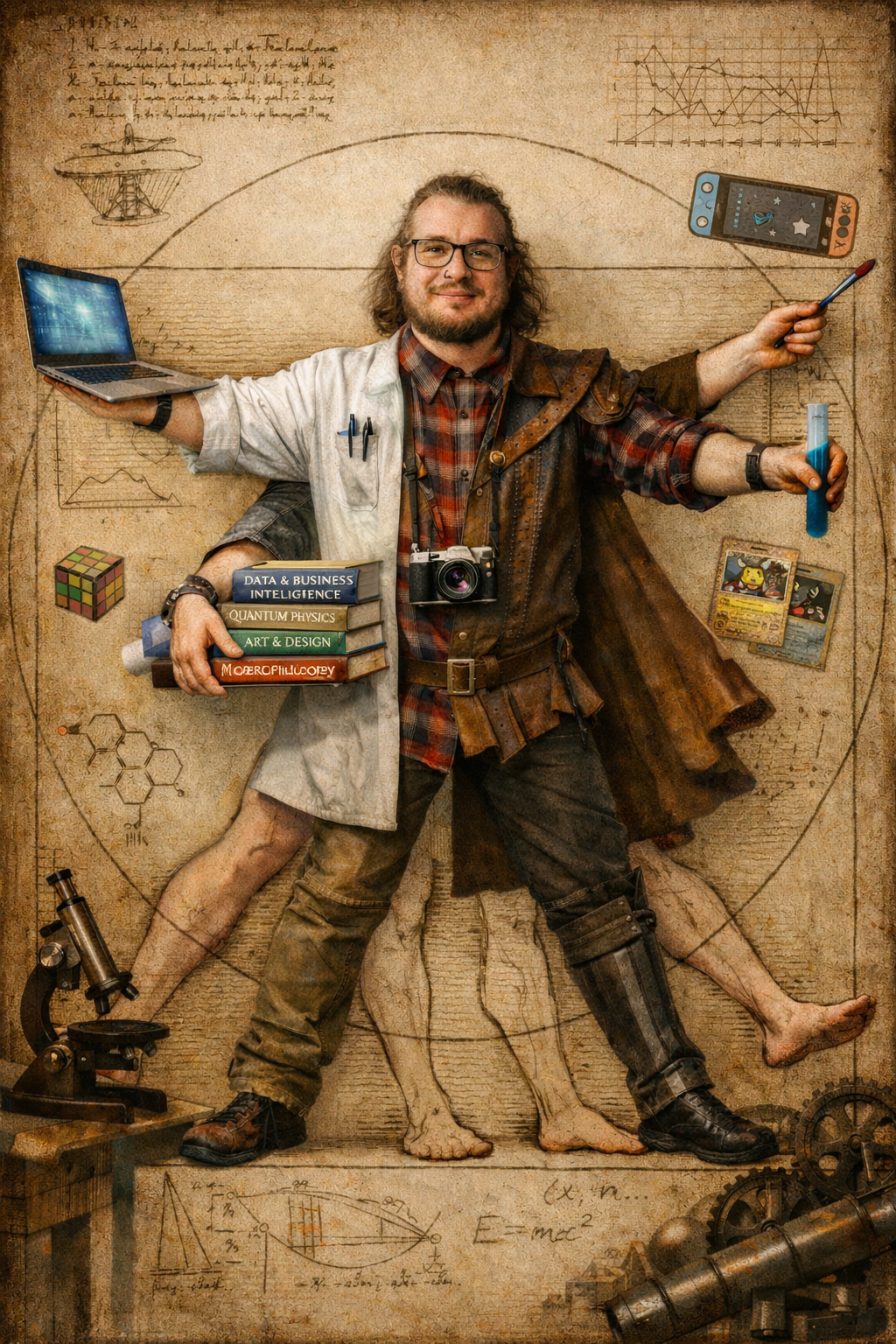
I was laid in bed watching YouTube Shorts like a brain-rotting ADHD millennial often does.
At 2am, might I add.
Which is ironic, because I actually prefer longer videos. Proper deep dives. The kind where someone spends 45 minutes explaining the philosophy of something incredibly niche while I slowly disappear into another interesting idea.
And my YouTube subscriptions definitely reflect that.
Alex O'Connor, host of the Within Reason podcast and the man behind Cosmic Skeptic: https://www.youtube.com/@CosmicSkeptic
Odysseas, who is probably the main reason I use Obsidian, read classic literature, and generally aspire to become a polymath. Ironically, while writing this I went to grab a link to his channel and realised he uploaded a video about becoming a polymath just nine days ago.
Great minds think alike, right? https://www.youtube.com/@odysseas__
And finally there's Success Chasers, which admittedly sounds like the sort of thing Andrew Tate might try to sell you a course through, but is actually one of the most beautiful and thoughtful creations on the internet. Philosophy explained through animated videos that somehow make huge ideas feel simple and… well… beautiful.
https://www.youtube.com/@SUCCESSCHASERS
Anyway, somewhere between doom-scrolling Shorts and watching people far smarter than me talk about philosophy, productivity, and the pursuit of knowledge…
I started thinking about something slightly dangerous.
What if I actually tried to become a modern polymath?
Want to know what a polymath actually is?
Before I go any further, it's probably worth answering the obvious question.
What actually is a polymath?
The word itself comes from ancient Greek. Poly meaning "many" and matheis meaning "learned." Put together, it basically means someone who has learned many things.
Later on, during the Renaissance, the idea became more specific. A polymath was someone with knowledge across many different fields who could move freely between them and connect ideas from completely different disciplines.
Which is where things start to get interesting.
Because modern life tends to do the opposite.
Most of us specialise. We pick a lane. We get good at one thing.
Our jobs are narrow, our roles are defined, and our careers often revolve around doing one specific task slightly better than the person sitting next to us.
That's not necessarily a bad thing. In fact, economically it makes a lot of sense. Even the industrial revolution figured that out. It's far more efficient if everyone focuses on one small part of a system instead of trying to do everything themselves.
But the idea of a polymath pushes against that a bit.
Instead of going deeper and deeper into one niche, a polymath spreads their curiosity wider. They explore science, philosophy, art, technology, writing, ideas… whatever grabs their attention.
Not because it's the most efficient way to make money.
But because the world is enormous and interesting and it feels like a bit of a waste not to explore it.
Now obviously this doesn't mean trying to learn literally everything. That's impossible. Even the famous polymaths we all think about built their skills over entire lifetimes, and many of them had the luxury of time, wealth, or patrons supporting them.
So the modern version looks a bit different.
It's less about mastering every subject under the sun and more about developing meaningful skills across different types of thinking.
Creative. Intellectual. Technical. Physical.
Which sounds wonderful in theory.
Until you realise it probably involves actually doing things instead of scrolling YouTube at 2am.
So what does a modern polymath actually look like?
Obviously I'm not planning to become Leonardo da Vinci overnight.
But if we strip the idea down to something practical, a modern polymath probably has a mix of skills across different domains of thinking.
So I made myself a checklist.
Not as some rigid life plan, but more as a way of asking:
Where am I already doing alright… and where am I massively slacking?
1. Intellectual Curiosity
What I'm doing
- Reading philosophy and classic literature
- Following creators like Alex O'Connor
- Writing reflective blog posts
- Accidentally spending two hours learning about something I didn't know existed ten minutes ago
2. Analytical Thinking
What I'm doing
- Power BI development
- Data modelling
- SQL
- Building dashboards and analytics systems
This one I feel fairly comfortable claiming.
3. Technical Skill
Being able to build things, not just think about them.
What I'm doing
- Building websites
- Creating tools and automation
- Working with data platforms and software
4. Creative Expression
Art, design, writing, storytelling.
What I'm doing
- Writing blog posts
- Designing dashboards
- Working with visual design and layout
- Building things that are not just functional but actually look good
5. Communication & Teaching
Explaining ideas and sharing knowledge.
What I'm doing
- Public speaking
- Running user groups
- Writing tutorials and guides
- Trying to make complicated topics understandable
6. Strategic Thinking
Games, systems, decision making.
What I'm doing
- Playing chess (current bullet rating: 1084)
- Systems thinking through work and projects
- Solving complex problems in slightly obsessive ways
7. Community & Social Contribution
Learning with others and contributing to communities.
What I'm doing
- Running the Norfolk Power Platform User Group
- Organising conferences
- Helping people break into tech and speaking
8. Physical Discipline
Movement. Sport. Using the body as well as the brain.
What I'm doing
Currently… not enough.
This is the category where the honest answer is:
I need to move my fat ass.
Which turns out to be an inconvenient requirement for becoming a polymath.
Historically, polymaths didn't just think about the world.
They moved through it.
They experimented with it. They built things with their hands. They studied anatomy. They walked everywhere.
Meanwhile, I spend most of my day sitting down staring at dashboards.
Which might mean the first step in becoming a modern polymath isn't learning another skill.
It might just be going for a walk.
So what happens now?
Well, this post is partly me thinking out loud.
But it's also a bit of a commitment.
If I'm serious about this whole modern polymath idea, then the next step is actually doing something about the gaps.
Which means this blog might turn into a bit of a logbook.
Posts about things I'm learning. Things I'm trying. Things I'm terrible at but attempting anyway.
Some of it will be intellectual.
Reading philosophy. Exploring ideas. Building things.
Some of it will be creative.
Writing. Design. Projects.
And some of it will be slightly more uncomfortable.
Like exercise. Or generally becoming a human being who occasionally leaves his chair.
So consider this the start of the experiment.
Let's see how far I get before I get distracted by another YouTube video about something completely unrelated.