You've got a tab open for ChatGPT. Maybe Claude in another. Someone on your team swears by Gemini because it lives inside the Google Docs they already pay for.
And every week a new "AI bro" tells you the one you're using is dead, the new one is a game-chang—
No. We're not doing that word here.
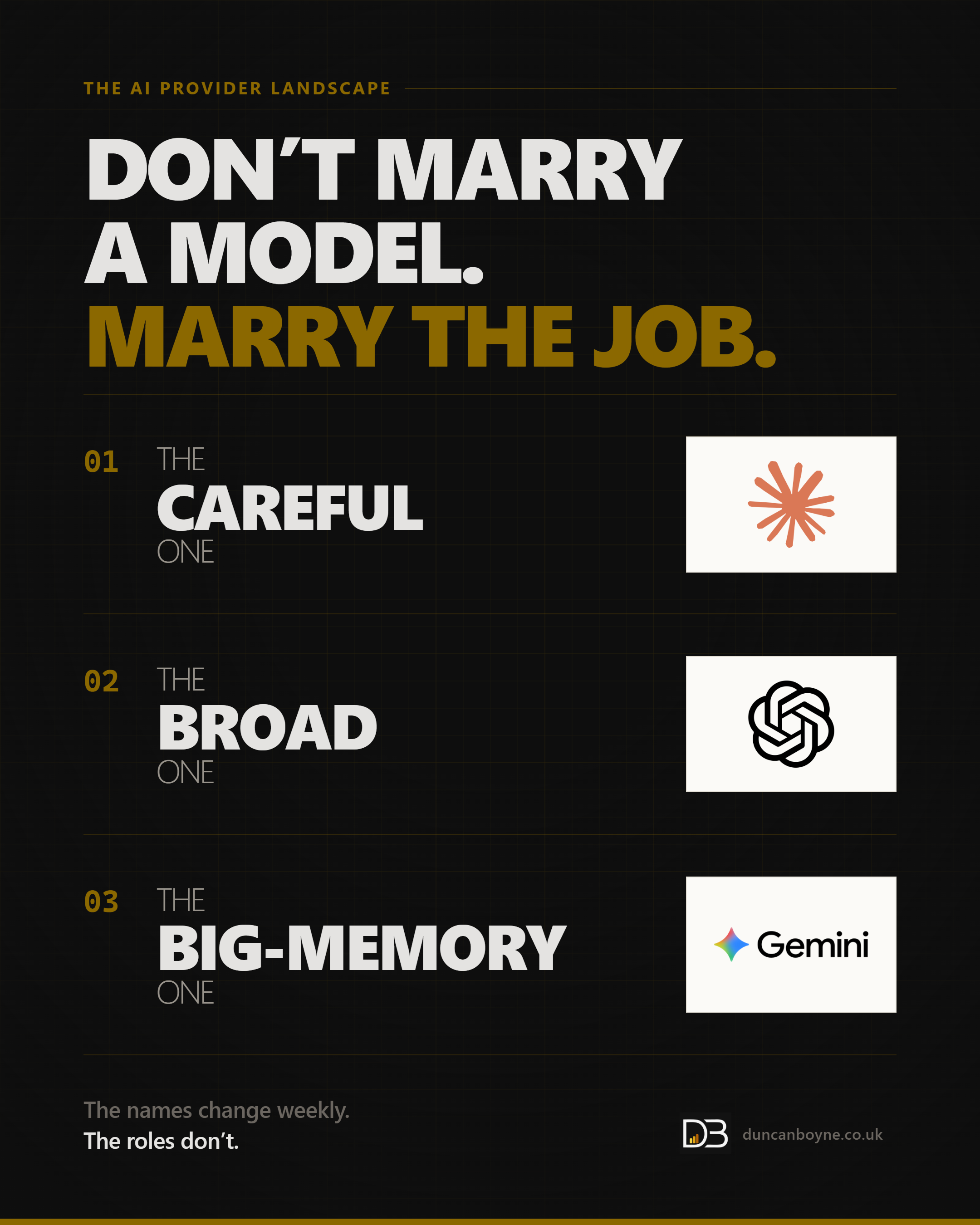
Here's the thing. The big three generalists aren't really competing to be the best AI. They've quietly split the map. Each one is now sharpest at a different job. So the useful question was never "which is best." It's "best at what, for whom, doing which task."
Let me walk you through what each one is actually for in mid-2026 — the real pairing of tool to job — plus a few niche ones worth knowing. I'll show you what I reach for, and where I've watched each one fall flat on its face. Because a tools post with no scars is just a brochure.
Claude (Anthropic) — the one you hand the hard, careful work to
Current line-up: Opus 4.8 at the top, Sonnet 4.6 as the everyday workhorse, Haiku 4.5 for cheap high-volume stuff.
What it's for: long-horizon coding, reasoning that has to hold together over a big task, and writing that doesn't read like a press release. Opus 4.8 landed in May with a specific pitch — it's roughly four times less likely than the previous version to let a flaw in its own code slide past unremarked. Read that again. The headline feature is that it's more willing to say "this bit is wrong." That's not a benchmark flex. That's the thing I actually want from a tool.
Reach for it when: you're building something real (an agent, a multi-step coding job, a long document), or you want help writing without it sanding your voice into corporate porridge.
Where it falls flat: it's the priciest output of the three at $25 per million output tokens, and it can be slower because it's thinking. If your task is "rephrase this email," you're paying Opus money to swat a fly. Use Haiku, or use something else.
The price ladder, so you're not guessing: Opus $5 in / $25 out, Sonnet $3 / $15, Haiku $1 / $5 per million tokens.
GPT (OpenAI) — the default front door, and the biggest toolbox
Current line-up: GPT-5.5 as flagship (built-in reasoning, ~1M context), the GPT-5.4 family — Mini, Nano, Pro — for cost-tuned production, and Codex for coding.
What it's for: being the place most people start, and having a tool for nearly everything bolted on — image generation, voice, computer-use, Deep Research, the lot. If "AI" means one product to a non-technical colleague, it means ChatGPT. That ubiquity is a real feature, not a vibe. The ecosystem is enormous and the integrations are everywhere.
Reach for it when: you want the broadest single surface — multimodal, agentic, research — without stitching five tools together. Or when you're onboarding people who've never typed a prompt and need the path of least resistance.
Where it falls flat: the model menu is a maze. GPT-5.5, 5.4, 5.4 Mini, Nano, Pro, 5.4 Pro, Codex — by the time you've worked out which one you're on, you could've made a cup of tea. And the flagship is the most expensive output of the lot at $30 per million. Powerful, yes. Simple, no.
Gemini (Google) — the one that reads the whole filing cabinet, where you already work
Current line-up: Gemini 3.1 Pro (2M-token context — the biggest you can buy), 3.5 Flash for speed and value, with 3.5 Pro arriving this month carrying a "Deep Think" mode.
What it's for: two things, and they're both about where the work already lives. First, context — a 2M-token window means you can hand it an hour of video, thirty thousand lines of code, or a stack of documents in one go and it holds onto them. Second, it lives inside Google Workspace. If your day runs through Docs, Sheets, Gmail and Drive, Gemini is already sitting in the room.
Reach for it when: you've got a lot of material to feed in at once, or your whole stack is Google and you want the AI that's native to it rather than a tab you alt-tab to.
Where it falls flat: the pricing has a trapdoor — for the Pro models, input cost roughly doubles once your prompt crosses 200k tokens. So the "huge context" headline and the "cheap" headline don't always hold hands. Read the meter before you fill the tank.
So which one, then?
Here's the honest version, no fence-sitting:
- Careful building and writing that sounds like you → Claude.
- Broadest single toolbox, easiest on-ramp for a team → GPT.
- Mountains of context, or a Google-shaped workplace → Gemini.
And the bit nobody selling you a £500 newsletter will admit: you probably want two of them, not one. I draft with one and pressure-test with another, because a single model agreeing with everything I say is a sycophant, not a second opinion.
The honourable mentions (the specialists earning their keep)
The generalists aren't the whole board. A few niche players are genuinely better at their one thing:
- Grok (xAI) — live web and X integration. If your job is news synthesis, market reaction, or "what is the internet saying right now," its real-time feed is a real edge.
- Perplexity — answers with sources attached. It's search that hands you a cited answer instead of ten blue links to sift. For research where you have to show your working, it earns the tab.
- DeepSeek — frontier-grade reasoning at roughly a tenth of the price. V3 lands near $0.27 in / $1.10 out per million. When cost is the constraint and the task is logical, it's hard to argue with.
- Mistral — strong open-weight European option with real multimodal chops, for the teams who need to run things on their own terms.
None of these is trying to be your everything. That's the point. They're scalpels, not Swiss army knives.
The bit where I tell you the truth
I built the first draft of this comparison a fortnight ago and it was wrong — half the model names had already moved. That's the real lesson buried under all the spec sheets: this stuff dates in weeks. The names will have shifted again by the time you build a habit around any of them.
So don't marry a model. Marry the job. Learn which kind of task suits which kind of tool, and swap the names out as they change. The careful one. The broad one. The big-context one. Those roles will outlive every version number on this page.
Your data — and your work — has a story. Pick the tool that tells it properly.
Sources (pulled live, June 2026):